 EN
EN  PL
PL  DE
DE 

B2B vs B2C sales – what are the differences?


B2B vs B2C sales are two worlds that are often lumped together – unfairly. Although both involve situations where businesses sell products and services, they differ significantly in the buying process, motivations, decision-making mechanisms, and the role of customers. The end customer in B2C often makes a purchase driven by emotion, while business buyers focus on concrete solutions, return on investment, and technical support. That is why companies operating in these two business models must design their offer, marketing, communication, and sales strategy in very different ways.
These key differences ultimately determine whether your company can effectively reach its target audience, understand the needs of consumers, and build long term relationships that lead to real success.
B2B vs B2C – how do these two sales worlds differ?
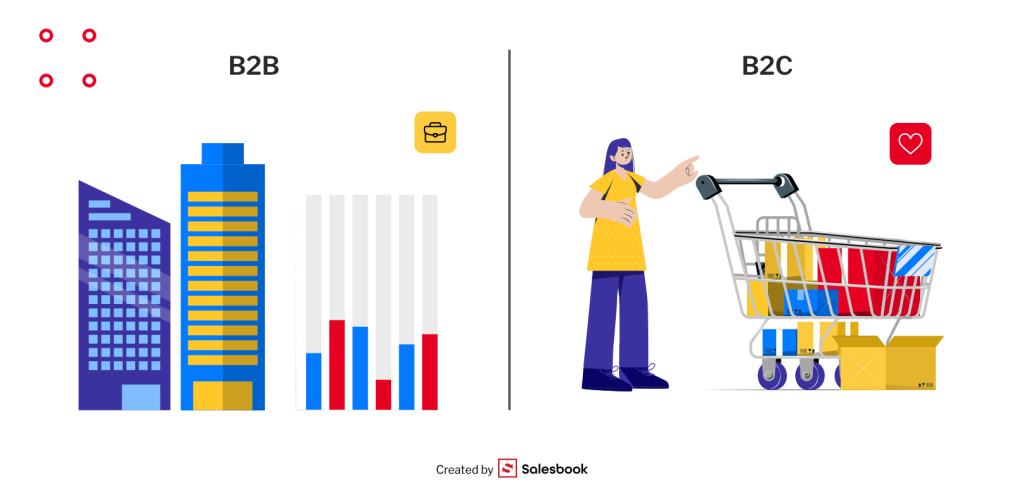
The fundamental difference between B2B and B2C lies in who you sell to. In business to consumer, you sell to individual customers or an individual consumer. In business to business, you sell to other businesses, where purchasing decisions are made by multiple stakeholders. Consumers are drawn to positive emotions, fast brand reactions, and loyalty programs. A B2B buyer, on the other hand, expects an individual approach, precisely prepared offers, and alignment with the organization’s internal processes.
These differences are visible even in payment terms. In B2C, fast online payments dominate, while in B2B issuing invoices, handling transaction documentation, and settlements based on accounting procedures are standard. In a business relationship, building customer relationships and long term relationships based on expertise, market trends, and the needs of a specific industry is essential.
The customer journey – how it works in B2B vs B2C
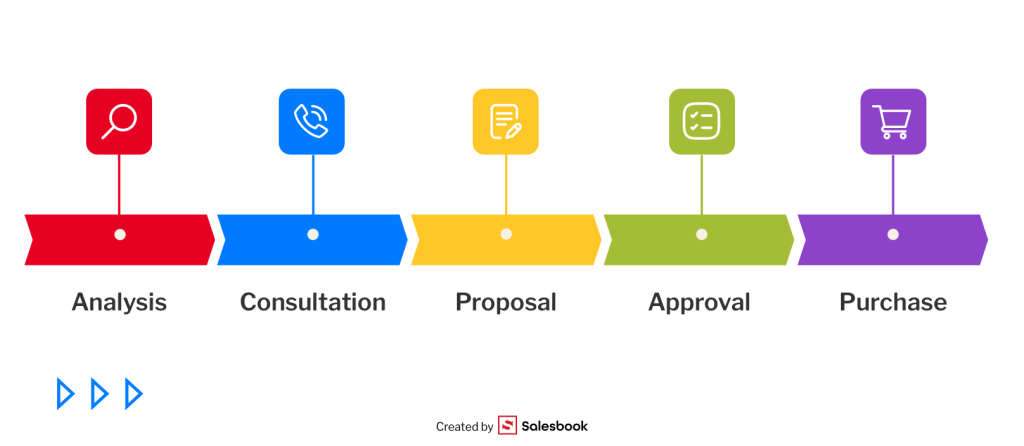
In B2C, the customer journey is usually simple. The consumer sees a product on a website or online platforms, compares prices, checks opinions, often sees ads, and makes making purchasing decisions quickly, frequently driven by emotion. In B2B, the sales cycle is much longer and more complex. It includes analyzing the needs of potential clients, verifying data, preparing offers tailored to one business or even one organization, and selecting payment terms that comply with internal procedures.
Companies that rely on data pay close attention to technical support, trade shows, tailored offers, and executing the sales funnel step by step. This is especially important when selling software, services, or tools that support digital transformation.
Number of stages and the length of the decision-making process
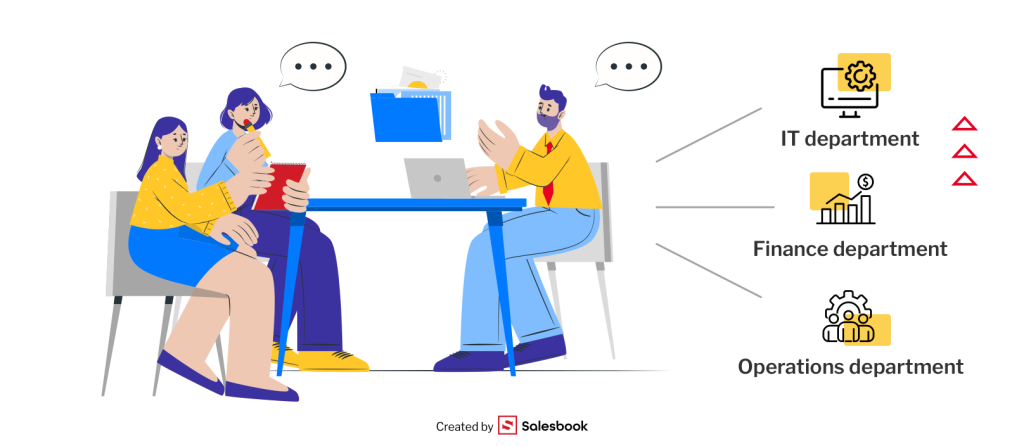
In B2B sales, the decision-making process is multi-stage and lengthy. It involves analyses, consultations, approvals, and coordination with other teams such as finance, legal, or IT. Several buyers participate, each evaluating price, value, risk, and impact on inventory, accounting, or internal workflows. A wrong choice can cost real money and disrupt the entire organization.
In B2C, decisions are made much faster. For individual customers, emotions, convenience, expectations, and simplicity at the point of sale matter most. Quick payments, mobile apps, and intuitive experiences are critical.
Emotional connection vs rational arguments
In B2C sales, emotions dominate. If a product creates a strong emotional connection, it often wins. In B2B, rational arguments matter most: ROI, security, reliability, and lifetime value. No one business wants to risk losses or operational issues.
B2C focuses on immediate gratification. B2B vs B2C shows that B2B relies on logic, numbers, and expertise. That is why B2B companies invest in educational marketing strategies, data-driven marketing campaigns, and well-structured offers rather than a one size fits all approach.
Who is the business customer and who is the consumer?
A business customer operates within company structures, procedures, and budgets. Their purchasing decisions must be justified with data and aligned with strategy. A consumer buys for personal use, guided by convenience, emotions, personal finance, and immediate benefits.
In B2B, every purchase is part of a bigger picture – cost optimization, process efficiency, or organizational growth. Research shows that in a typical business to business buying process, 6–10 people may be involved, each assessing the offer from a different angle: legal, technical, financial, or operational. Each of them influences the final decision and the customer lifetime.
In business to consumer, there are far fewer barriers. Speed, simplicity, brand perception, and overall customer satisfaction matter most.
A well-known example that summarizes this difference is a quote by Peter Drucker:
“The aim of marketing is to know and understand the customer so well the product or service fits him and sells itself.”
Peter Drucker, Management: Tasks, Responsibilities, Practices, HarperBusiness, 1993
In B2B, knowing the customer means understanding processes, tools, teams, and how the solution creates value for the entire business. In B2C, it means understanding the motivations of a single person, their needs, habits, and relationship with the brand.
Expectations, budgets, and how offers are evaluated
A business customer focuses on return on investment, project risk, scalability potential, and reliable customer data that allows them to assess whether a solution will genuinely improve how the company operates. A consumer buys because a product solves a personal problem—and does so immediately, not as part of a long analysis.
McKinsey points out that business to business companies today expect lower risk and full cost transparency. 71% of businesses want clear ROI before sales conversations even begin, which forces companies to create highly precise offers and pricing structures.
In business to consumer, the budget is personal, more flexible, and often impulsive. The individual consumer compares products mainly by price, opinions, and convenience—this is why brands invest heavily in emotional communication, social media, and loyalty programs.
A business customer evaluates offers differently and analyzes:
- alignment of the solution with internal processes of the organization,
- impact on teams and efficiency,
- required payment terms,
- implementation time and technical support,
- operational risk.
For consumers, it often comes down to one question: is this something I want to have “here and now” for personal use?
Customer data requirements and personalization
In B2C, personalization has become the standard. According to McKinsey’s Next in Personalization report, 71% of consumers expect personalization, and 76% of them are frustrated when they do not receive it.
This means brands must use customer data to tailor offers, product recommendations, marketing campaigns, and communication—often through online platforms, mobile apps, and personalized ads.
In B2B, personalization looks completely different. Instead of product recommendations, the focus is on tailoring a solution to a specific business, its processes, industry, structure, and teams. Companies that rely on data want details: KPIs, benchmarks, case studies, and clear information on how software or services integrate with their existing tools and workflows.
The differences are clear:
- in B2C, data is used to predict the needs of individual customers,
- in B2B, data supports designing solutions that require analysis, comparisons, scope definition, and building long term relationships.
In both models, one rule applies: companies that use customer data better achieve higher conversion rates and reach potential customers more effectively. However, the way this data is used differs fundamentally—and this is one of the key differences in b2b vs b2c.
Market examples – how B2B vs B2C differences impact sales results
The difference between B2B and B2C becomes most visible where it directly affects real business results—both for companies operating in b2b sales models (such as manufacturing or logistics) and for B2C brands competing for consumer attention.
1. Siemens (B2B): process-driven, multi-stage, data-based decisions
Siemens provides industrial IoT, automation, and production systems. Their b2b sales approach is built on hard data and long term relationships.
In the Siemens Digital Industries report, the sale of automation systems is described as a process where ROI analysis and operating costs were the main factors influencing business buyers—not emotion.
This is a model where the offer presentation includes energy savings, reduced downtime, IT integration, and production efficiency. The buying process is driven by structured evaluation, data analysis, and measurable value.
2. Caterpillar (B2B): technical consulting and multiple stakeholders
Caterpillar sells heavy equipment, so its customers—construction and infrastructure companies—do not purchase impulsively. They analyze costs, durability, and operational value.
In its Annual Report, Caterpillar highlights that most business buyers require technical consultations during offer evaluation and that purchasing decisions involve multiple stakeholders from technical, financial, and operational teams.
This is a clear example of a B2B model where sales results depend on teamwork on the customer side and strong arguments—not emotional messaging.
3. Maersk (B2B): sales based on stability, delivery time, and risk analysis
Maersk, a global logistics operator, shows that b2b vs B2C is about processes rather than short-term emotion. In its materials, the company emphasizes that B2B customers expect predictability and stability, and that making purchasing decisions depends on delivery-time data and operational costs.
This clearly demonstrates that for business clients, minimizing risk and understanding the impact on the entire operational chain matters far more than emotional appeal.
4. Sephora (B2C): personalization and emotional shopping experience
Sephora is a model business to consumer example where customer experience and emotions directly drive sales.
In McKinsey’s personalization report, it was shown that implementing personalized offers at Sephora increased customer engagement and improved sales results, because product recommendations are based on user preferences and personal data.
This is a completely different world than business to business—the consumer buys based on experience, brand, and emotional communication.
5. IKEA (B2C): simplicity of the buying process and emotions as a conversion driver
IKEA confirms that consumers make purchasing decisions driven by emotion and convenience. In the IKEA Annual Summary & Sustainability Report, the company emphasizes that simplifying the customer journey—easy payments, intuitive stores, visual inspiration—directly increases sales.
This is a model where every stage, from walking through the showroom to checkout on the website, is designed to trigger positive emotions and accelerate the buying process.
How to adapt the sales process to different customer types?
Adapting the process to sell products to different audiences depends primarily on whether you operate in b2b vs b2c. In B2C, speed, simplicity, and emotions guide potential customers toward quick decisions. In B2B, the process is far more analytical—it requires hard data and tailoring the solution to a specific business, its structure, and the type of customer relationships the organization wants to build over time.
In both models, understanding what motivates the target audience is critical—whether it is convenience and emotion, or logic and predictability. Only then can marketing strategies and sales activities be planned effectively to acquire loyal customers and maintain high-quality relationships.
What to automate and what to personalize?
In B2C, automation should handle repetitive elements: payments, recommendations, post-purchase service, and social media communication. The goal is convenience and a smooth experience that allows customers to move quickly through the sales funnel.
In B2B, automation serves a different purpose—it speeds up needs analysis and organizes information about potential clients. Personalization, however, is required for:
- preparing presentations and offers tailored to a specific one business,
- communication with buyers and decision-makers,
- building long term relationships within complex organizational structures.
In b2b sales, personalization is a strength, while automation allows teams to focus where it truly makes a difference between b2b success and failure.
Where does Salesbook help in both models?
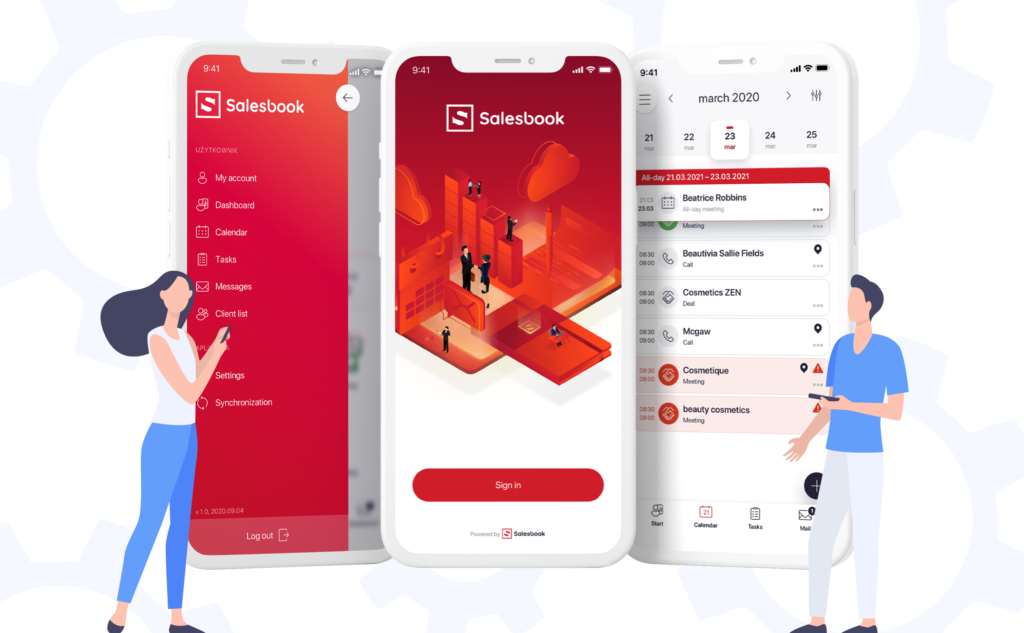
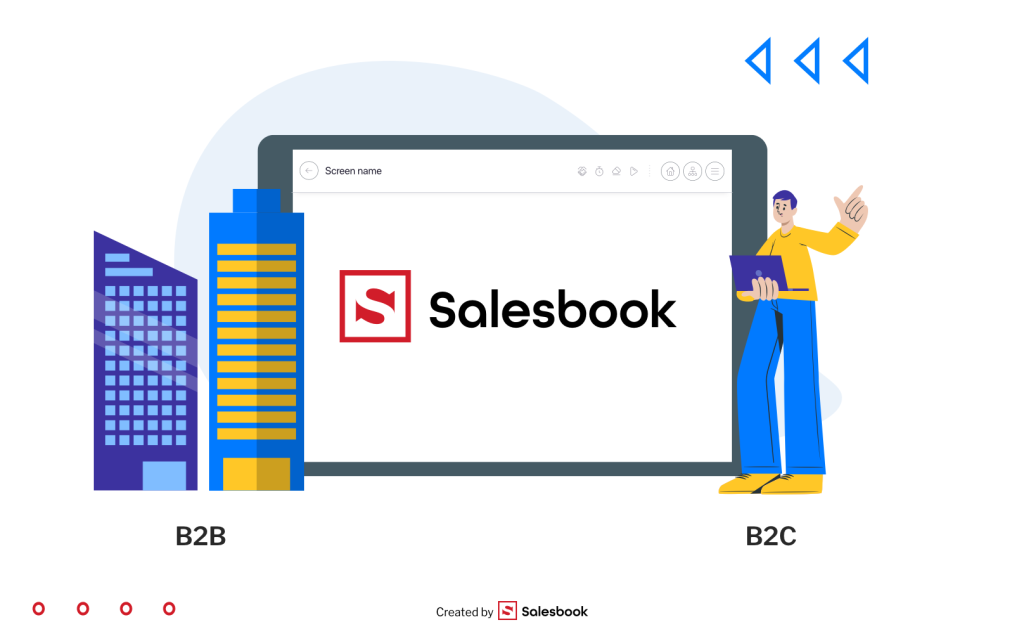
Salesbook supports b2b and b2c companies by eliminating manual work, accelerating processes, and allowing teams to focus on what truly impacts results.
- tailored offers and presentations created in minutes,
- a structured database for each customer,
- automated offer preparation and invoicing aligned with payment terms,
- post-sales support and building stable, long term relationships.
In B2C, Salesbook supports:
- managing conversations at the point of sale,
- collecting data about consumer needs,
- automating communication with potential customers,
- shortening the sales cycle and increasing conversion.
In both cases, the goal is simpler sales work and greater repeatability of actions that translate into loyal customers.
Summary – what should you remember?
The key differences between b2b vs b2c affect the entire process—from the first interaction, through needs analysis, to closing the deal. In business to consumer, emotions and speed matter most. In business to business, data, logic, and tailoring solutions to a specific company are critical.
In both models, understanding the type of relationships you want to build—fast and transactional or strategic and long-term—is essential. Regardless of the segment, businesses that successfully combine automation with personalization win. Tools like Salesbook make this easier by organizing how businesses sell products and supporting sales teams whether they sell to consumers or other businesses.
FAQ
1. What are the key differences between B2B and B2C sales?
The main differences relate to the buying process, customer motivations, and relationship types. In B2C, decisions are fast and driven by emotion. In B2B, the process is longer, involves multiple stakeholders, and is analyzed in detail. Business buyers expect data, clarity, and clear ROI.
2. How should an offer be tailored to a business customer?
In B2B, it is essential to adapt the solution to a specific business—its industry, processes, and organizational structure. Offers should be data-driven, focused on long-term benefits, lifetime value, and measurable value.
3. What should be automated in the sales process?
Automation should support repetitive tasks such as data collection, managing potential clients, document preparation, and post-sale service. Personalization is crucial for conversations, presentations, and relationships—especially in B2B, where each purchase affects the entire organization, its finance, inventory, and overall success.
4. How does pricing work in B2B and B2C, and when is volume-based pricing used?
In B2B, pricing is often negotiated and depends on scale. Volume based pricing is common, especially when a manufacturer sells large quantities to distributors or many retailers. Prices reflect order size, long-term cooperation, and forecasted demand. In B2C, pricing is usually fixed and transparent, with little room for negotiation, because products or services directly target individual buyers rather than wholesale partners.
5. How does personalization differ in B2B and B2C marketing communication?
In B2C, personalization focuses on personalized content—recommendations, offers, and messages tailored to individual preferences and behavior across websites, mobile apps, and ads. In B2B, personalization is less about content volume and more about relevance: adapting communication, offers, and solutions to one specific business, its processes, and decision-makers, often when a manufacturer or service provider works services directly with a client rather than through mass retail channels.
Table of Contents