 EN
EN  PL
PL 



Business Negotiations – Definition, Types, and Stages


Business negotiations begin long before the actual meeting at the bargaining table. Understanding the different types of negotiations helps you choose the right negotiation style and apply the most essential negotiation skills for the specific situation, the expectations of two or more parties, and the broader business context. It’s equally important to recognize various approaches because other parties may use competitive strategies or adopt a more cooperative approach than you anticipate — and flexibility significantly increases your chances of successful negotiation.
The key is to focus on underlying interests, not just positions — that’s how both sides can achieve mutually beneficial solutions instead of falling into a zero-sum mindset.
In practice, professional negotiators know that success depends on thorough preparation, data analysis, and attentiveness to subtle cues coming from one’s opponent. Applying active listening and emotional intelligence helps you better understand the other party’s objectives and build rapport during the communication process. Understanding those motivations allows you to craft value packages that balance costs and risks for both sides, paving the way for joint gains.
This guide draws on insights from negotiation theorists and models such as the Harvard Negotiation Project, walking you through the definition, main types, and stages of negotiation — showing how experienced negotiators can lead conversations in such a way that both sides reach agreements and build good relations that truly last.

What Are Negotiations? Definition and Purpose in the B2B Context
Negotiations in business are a structured communication process in which two or more parties work to develop a mutually beneficial solution that satisfies various interests—often under constraints such as limited resources, tight deadlines, and sales targets pressure. It’s not a battle of egos, but rather a form of conflict resolution, a conversation about underlying interests, value, and opportunity.
In the B2B world, parties negotiate to reach a verbal agreement or a formal contract that balances both sides’ objectives. Effective negotiation skills are critical for finding middle ground that protects your margin without undermining the other party’s objectives. When disagreements occur, experienced negotiators rely on principled negotiation—a framework introduced by the Harvard Negotiation Project—which emphasizes fairness, objective criteria, and creative problem-solving instead of positional bargaining.
Understanding the other side is the foundation of every successful negotiation. Each organization has unique goals, decision limits, and priorities, which is why selecting the right cooperative approach—whether for a strategic partnership or a job offer discussion—is a key skill. Sometimes, a factual and analytical style works best; other times, positive emotions, empathy, and emotional intelligence lead to good relations and stronger collaboration.
Ultimately, the best professionals know that success in negotiating comes from making both sides feel on the same page. In real life, trust—not pressure—is what ensures both sides walk away with a great outcome.
Interests vs. Positions – Why This Distinction Determines the Outcome
Negotiations aren’t a clash of offers—they’re an alignment of interests. A position describes what a party wants (“a 10% discount”), while an interest explains why (“our quarterly budget closes next month”). Only by uncovering the motivations behind each side’s demands can you identify creative solutions—like adjusting the payment schedule, modifying the scope, or adding extra value through services.
The best negotiators listen, ask probing questions, and paraphrase to reveal what truly drives the other party’s expectations. This approach requires a rational, fact-based style focused on data and business consequences rather than emotion. It also helps you choose the right negotiation style—for example, an integrative approach, built on collaboration and the pursuit of win–win outcomes.
It’s important to remember that in successful negotiations, a concession should never be one-sided. The “give–get” principle keeps the conversation balanced and ensures the other side perceives it as a fair exchange rather than an attempt at domination.

When to Negotiate—and When Not To (Profitability Criteria)
Not every conversation requires negotiation. Sometimes it’s better to postpone a discussion than to force it when there’s no real chance of success. You should enter negotiation mode when:
- there’s room for compromise and at least one element of the offer (price, scope, or deadline) can be adjusted by both sides;
- the potential value of the relationship outweighs the time and effort invested by both parties;
- you have prepared alternatives and a negotiation style suited to the situation (for example, a fast, decisive approach under time pressure, or a consultative style for complex contracts).
Avoid negotiations when:
- neither party has flexibility (e.g., fixed tenders or regulated pricing);
- the other party is pushing “at all costs,” ignoring collaboration principles;
- a lack of trust or transparency risks damaging the relationship.
Before deciding whether it’s worth engaging, calculate the full cost—time, implementation risks, possible delays, and impact on your sales pipeline. Only then should you choose the right negotiation style—whether factual, collaborative, or transactional. A deliberate choice of style isn’t reactive; it’s how you maintain control over both the process and the outcome.
Types of Business Negotiations
In B2B practice, there’s no single universal way to conduct a negotiation. Every counterparty has its own goals, resources, and constraints. A skilled negotiator recognizes which type of negotiation they’re in and adapts their approach accordingly.
Business literature most often distinguishes three core types:
- Distributive negotiations,
- Integrative negotiations,
- and their variants—cooperative and competitive styles.
Today’s negotiation process also includes remote and hybrid formats, which demand different tools and interpersonal skills than traditional in-person meetings.
Distributive vs. Integrative Negotiations (Win–Lose vs. Win–Win)
This distinction is a cornerstone of modern negotiation theory.
Distributive negotiations—often called hard bargaining—are like dividing a pie: each side is fighting for the biggest possible slice. In this model, one party’s gain automatically means the other’s loss. It’s typical for short-term transactions, such as setting equipment prices or negotiating discounts. This approach works best when the terms are fixed and the relationship isn’t strategically important.
Integrative negotiations, on the other hand—sometimes called soft or win–win negotiations—focus on joint problem-solving. Here, both sides work to expand the total value, not just haggle over price. That value might include better quality, extended warranties, faster delivery, or additional services. A rational, fact-based style and a collaborative attitude build trust, and open information exchange makes it easier to reach an agreement that’s both stable and mutually satisfying.
Example: A software vendor and a client don’t have to negotiate only the license price—they can discuss implementation training, response times, or system integrations. The result? Both sides win: the client gains a comprehensive solution, while the provider secures a long-term partnership.
Cooperative vs. Competitive – Choosing the Right Style for the Situation
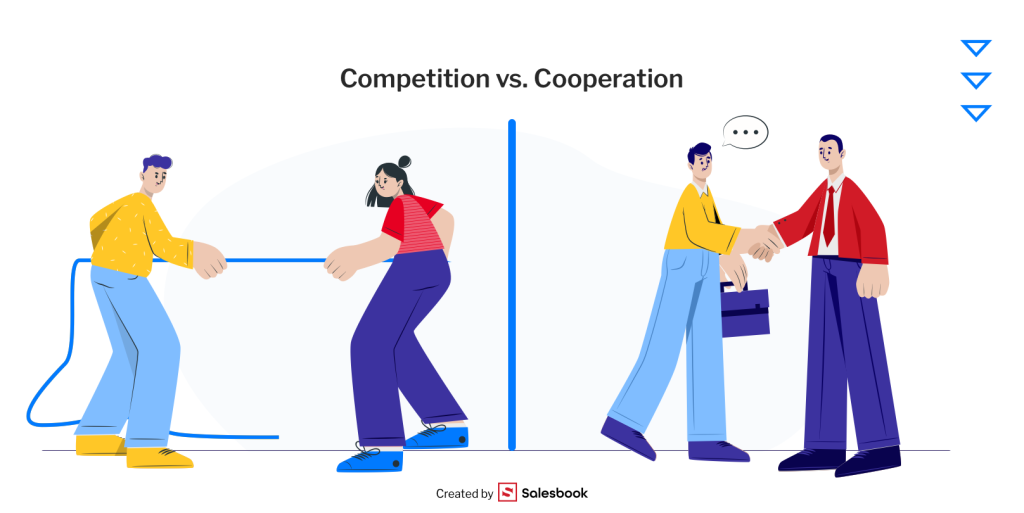
The right negotiation style is all about reading the situation correctly. A cooperative style works best when the relationship with a client or partner is strategic, and the goal is to create mutual value. This approach relies on trust, open communication, and a shared effort to reach an agreement that benefits both sides. Negotiators using this model focus on interests, not rigid positions.
In contrast, a competitive style dominates when speed and results matter most—such as in price negotiations or under time pressure. It often involves harder tactics: strong arguments, limited concessions, and establishing psychological leverage. This style can work in the short term, but in the long run it carries risks: the other side may feel exploited, which can damage the relationship and hinder future collaboration.
In reality, the best negotiators can combine both styles. They approach the other party in a factual, professional manner but remain agile—knowing when to increase pressure and when to look for compromise. The ability to shift negotiation styles depending on the conversation’s dynamics is what distinguishes an experienced professional from a transactional salesperson.
Remote and Hybrid Negotiations – Specifics and Best Practices
In modern business, more and more negotiations happen online—via Teams, Zoom, or even email. Remote negotiations differ from traditional ones not only because of the lack of face-to-face contact, but also because it’s harder to read emotions and reactions from the other party. This calls for a different communication style—more structured, data-driven, and linguistically precise.
In online negotiations, maintaining focus and managing the process clearly is critical. It’s worth:
- agreeing on the agenda and duration of the meeting in advance,
- confirming decisions in writing after each key point,
- using a fact-based, neutral tone—avoiding unnecessary emotions or digressions,
- leveraging digital tools like CRM systems, margin calculators, and offer comparison sheets.
Hybrid negotiations, which blend in-person and virtual meetings, demand even greater discipline and planning. The other side might work at a different pace, operate in another time zone, or communicate in a distinct style. Success depends on clarity, transparency, and the ability to build relationships despite physical distance.
Remember: effective negotiations aren’t about winning at all costs, but about creating common ground where both sides feel like winners. That’s what separates a hard seller from a mature negotiator—the ability to create value through understanding, adaptability, and mastery of the negotiation process.

Preparing for Negotiations – The Foundation of Success
In the B2B sales, most negotiations are won long before you even sit at the bargaining table. Thorough preparation determines whether professional negotiators follow a structured plan or end up reacting impulsively to the other party’s moves. True readiness goes far beyond memorizing your price list — it’s about clarifying goals, analyzing underlying interests, defining limits for possible outcomes, and designing a strategy that considers multiple issues and procedural matters that can influence the deal.
A successful negotiation demands not only knowledge but also mastery of key skills such as strategic thinking, active listening, and emotional control. Skilled negotiators maintain focus on objective criteria, even when conflict arises or one party attempts to apply pressure. Having a backup plan and strong alternatives helps you stay confident and prevents irrational behavior under stress.
The better you understand the other’s perceptions and motivations, the easier it becomes to find agreeable solutions and identify opportunities for joint gains. Adapt your negotiation style to the specific context — whether you’re negotiating a job title, a budget increase, or a long-term partnership. Remember, the goal is not simply to win, but to reach an outcome that both sides see as fair, practical, and sustainable.
Goals, Interests, Priorities, and Concession Scenarios
The first step in preparation is defining your goal — what you want to achieve and the conditions required for success. It’s helpful to distinguish between your minimum goal (for example, maintaining the relationship) and your optimal goal (for instance, increasing profit margin by 5%).
Next comes analyzing interests. Interests are the motivations behind each side’s expectations — such as the need for stable supply, shorter payment terms, or stronger post-sale support. In practice, understanding the other side’s interests often opens the door to creative solutions that weren’t obvious before.
Before entering the meeting, develop several concession scenarios — what you can give up, in what order, and in exchange for what. The “give–get” principle protects you from one-sided concessions and helps you stay in control of the negotiation’s flow. In challenging moments, maintain a fact-based, objective style — focusing on business logic, not emotions.

BATNA and ZOPA – How to Define Them in Practice
Two concepts every professional negotiator should master are BATNA (Best Alternative to a Negotiated Agreement) and ZOPA (Zone of Possible Agreement).
BATNA represents your best alternative in case no deal is reached — the answer to the question: What will you do if the negotiation fails? Knowing your BATNA gives you strength, because it allows you to negotiate confidently and avoid accepting conditions that are disadvantageous.
ZOPA, on the other hand, is the range where both parties’ interests overlap — the zone in which you can find a mutually satisfactory solution.
In practice, it’s worth creating a simple BATNA/ZOPA matrix that maps potential price points, timelines, risks, and contract conditions. This tool helps you realistically assess where the boundary of possible agreement lies — and where the area begins in which it’s smarter to walk away from the table.
Gathering Data: Prices, Benchmarks, and Decision-Making Constraints on Both Sides
There are no effective negotiations without data. The more you know about market conditions, trends, and purchasing behaviors, the stronger your arguments become. Gather information from multiple sources: industry reports, competitor offers, cost analyses, and your own history of cooperation with the company.
It’s also essential to understand decision-making limitations on both sides: who makes the final call, what the approval process looks like, and how long it takes the other party to validate changes. In many cases, lacking this insight leads to false assumptions and unnecessary tension.
Top-performing negotiators rely on a fact-based, objective style — they don’t promise what they can’t deliver, and they don’t react emotionally when the other side tests their boundaries. Hard data and clear arguments are far more persuasive than vague declarations or emotional appeals.
The Negotiation Team and Its Roles
In complex B2B negotiations, the seller’s side often includes several participants: a salesperson, product manager, financial specialist, or legal advisor. Each person should have a clearly defined role, scope of responsibility, and authority to speak at specific moments.
A typical negotiation team might look like this:
- Lead negotiator – coordinates the entire process, manages the strategy, and maintains communication with the other side;
- Subject matter expert – supports the discussion with technical or financial insights;
- Observer – monitors the tone, emotions, and reactions of the other party;
- Decision-maker – approves the final contract terms and formalizes the agreement.
It’s essential that everyone knows their task and doesn’t overstep another person’s role — chaos at the table is the best gift you can give the other side. The team must operate like a well-synchronized machine: cohesive, composed, and focused on reaching a mutually beneficial agreement.
Preparation isn’t just about analyzing data — it’s about scenario planning, rehearsing communication strategies, and anticipating how the other side may respond. The more energy you invest before the meeting, the greater the chance that the conversation ends with a solid, sustainable solution. This is where a professional negotiator’s true advantage begins — not in words, but in planning.
Stages of Negotiation – From Opening to Closing
Every effective negotiation follows a logical sequence, with each stage serving a specific purpose. Skipping even one step can cost you trust, control, or leverage. As negotiation theorists point out in classic negotiation books, consistency and structure are what separate amateurs from professional negotiators.
In practice, most current negotiations unfold through three main phases: preparation, active discussion, and closing. Each stage demands not only technical know-how but also the ability to build rapport with one’s opponent, manage emotions, and avoid taking advantage of temporary leverage. Successful negotiators never lose sight of basic needs—security, respect, and fairness—which underpin every lasting business relationship.
Below, we’ll focus on the five key steps that form the heart of the process — and lead to a durable, profitable agreement for both parties.
Opening and Setting the Ground Rules
The first few minutes of a conversation can define its entire course. A negotiator who can create an atmosphere of trust has a far better chance of controlling the meeting’s dynamics. Early in the discussion, it’s crucial to clearly establish the framework: the duration, scope, goals, and even the decision-making process.
This is your moment to demonstrate professionalism — not through rigidity, but through calm confidence and clarity of intent. Be specific, yet flexible. Present yourself as a partner, not an opponent.
Example: “I’d like us to define the key terms of cooperation today and outline the next steps.”
Such an opening sets the tone for the entire conversation and helps align both sides toward a shared goal.
It’s also worth defining the “rules of engagement” — how arguments will be presented, when breaks can be taken, and who will summarize the conclusions. While it may sound formal, this structure keeps the discussion organized and minimizes the risk of confusion later on.

Diagnosing Needs and Mapping Interests
This is the stage where experienced negotiators gain a real advantage. Instead of jumping straight into proposing solutions, they ask questions and listen. The goal is to uncover the other side’s needs — not only what they want, but why.
In B2B negotiations, needs can span multiple dimensions: security, financial liquidity, delivery stability, payment flexibility, or service quality. Skillfully mapping these interests helps you tailor your communication strategy and identify areas for collaboration.
Be inquisitive, but stay professional. Questions such as “What are your top priorities for this partnership?” help reveal not only expectations but also limitations. The better you understand the underlying motivations of your counterpart, the easier it becomes to reach an agreement based on real interests rather than assumptions.
Proposals, Anchors, and Counteroffers
This is where the conversation gains momentum. The first offer, also known as the anchor, carries enormous weight — it sets the psychological reference point for the entire negotiation. A well-thought-out anchor helps you frame the discussion in a way that favors your objectives.
Be cautious, though: an overly aggressive proposal can alienate the other side and damage future cooperation. The most effective approach is a fact-based style supported by data, benchmarks, and real market examples.
Example: “Based on average industry rates, our solution falls within the X–Y range.”
At this stage, counteroffers will inevitably appear. Don’t treat them as threats — they’re part of the process. Negotiation is a balancing act — testing flexibility, exploring variants, and finding combinations that lead to a shared compromise.
Concessions, Packages, and Boundary Conditions
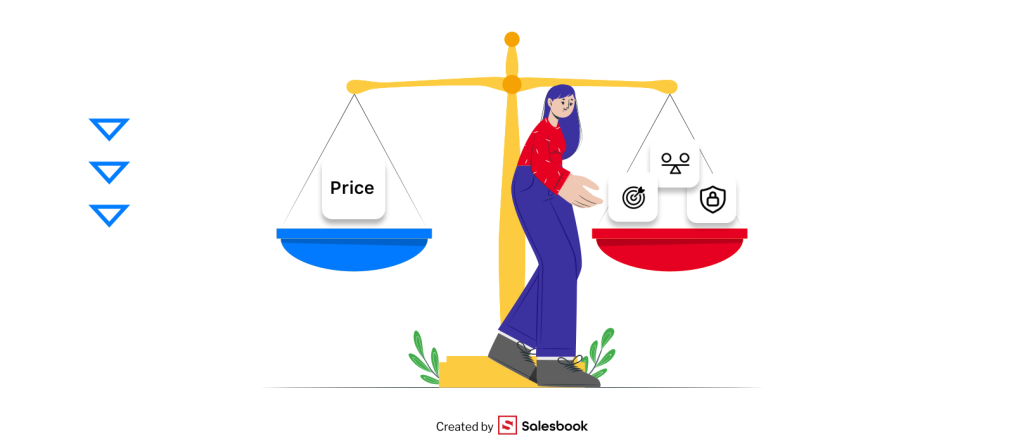
This is one of the most delicate moments in the entire negotiation process. Every concession should be deliberate and tied to a specific condition — otherwise, you risk losing control. Instead of lowering your price, offer added value: a shorter delivery time, complimentary training, or improved payment terms.
Know the limits of your flexibility. It’s wise to prepare a list of possible concessions and firm boundaries beforehand — things you’re willing to trade and those you won’t cross. In challenging negotiations, this clarity often separates professionals from amateurs.
Follow the exchange principle — “if–then.”
For example: “If we increase the volume by 20%, I can reduce the price by 5%.”
This approach keeps the discussion balanced and shows that every concession has a clear business rationale, reinforcing your credibility and preserving value for both sides.
Closing and Confirming Agreements (Contract and Next Steps)
The final stage of a negotiation is no place for improvisation. As the conversation nears its end, be precise: summarize the agreements, clearly state the conditions reached, and make sure both sides interpret them in the same way.
In practice, a simple summary framework works best:
- What the agreement covers – the main areas and terms that were finalized;
- What the next steps are – who acts, when, and to what extent;
- How the process will close – contract signing, implementation dates, and operational contacts.
Ensure that the finalization feels like a natural conclusion, not a forced ending. Be calm, factual, and thank the other party for their collaboration — leaving a positive impression that strengthens the relationship and increases the chances of future opportunities.
Remember: in negotiations, those who win are not the loudest, but the best prepared — the ones who plan, listen, and execute their strategy consistently.
Key Negotiation Techniques in Practice
Understanding negotiation techniques is like learning the rules of chess — it doesn’t guarantee victory, but it allows you to anticipate moves and act with intention. In reality, negotiations are a blend of context, emotions, and data. Every effective negotiator has a set of tools that help maintain control over the conversation, build leverage, and guide it professionally.
Below are four of the most important techniques you can apply in your daily business negotiations.
Anchoring and Multi-Point Anchoring
Anchoring is a technique that involves introducing the first proposal — the so-called anchor — to establish a reference point for the rest of the discussion. What’s said first often subconsciously shapes how the entire negotiation is perceived.
Example: If the discussion starts with a price of $100,000, even a counteroffer of $90,000 feels like a major concession. But if the first offer were $80,000, those same numbers would be seen very differently.
Anchoring works because people tend to “stick” to the first figure they hear. That’s why it’s crucial to be the first to set the frame — in a factual and data-driven way, supported by benchmarks.
In a more advanced version, you can use multi-point anchors: instead of presenting a single number or condition, show three collaboration options — for example, basic, extended, and premium. This approach helps the other side see the range of possibilities while allowing you to control the narrative. In most cases, your middle option will become the natural point of reference — and often, the one that gets chosen.

Framing and Option Ordering
This is one of the most elegant and effective negotiation techniques. Framing means presenting your proposal in a way that directs the other party’s attention to the aspects that best support your strategy.
Example: Instead of saying “This costs $50,000,” say “This investment starts generating returns after just three months of cooperation.” The difference is subtle but powerful — one focuses on expense, the other on value.
Be aware that the other side might use framing on you as well. If you hear, “This is a big cost for us,” you can reframe the discussion by asking, “I understand you’re focused on ROI — let’s talk about how we can accelerate it.”
Option ordering is about how you present your choices. Start with the most comprehensive package and move down to simpler or cheaper options. This naturally builds perceived value and prevents the conversation from revolving solely around price.
Calibrated Questions and Control Summaries
This is the technique that separates experienced negotiators from those who simply “talk.” Calibrated questions help you understand how the other side thinks and keep control of the discussion — without confrontation.
Examples of effective calibrated questions include:
- “What would your ideal scenario look like?”
- “What would need to happen for us to move forward?”
- “Which element of this proposal is most important to you?”
These questions help you uncover your counterpart’s true priorities and avoid false assumptions. The technique works even in tense situations because it doesn’t attack — it invites collaboration.
Control summaries are a natural follow-up. After each key stage, say something like:
“Just to make sure we’re aligned — we’ve agreed that…”
This simple habit prevents misunderstandings and keeps your strategy clear throughout the process.
Trade-Offs Instead of One-Sided Concessions
The biggest mistake in negotiations? Making concessions without getting anything in return. In the professional world, the “give–get” rule applies — every concession should be tied to a condition.
Instead of saying, “I can lower the price,” say, “If we increase the order volume by 20%, I can lower the price by 5%.” This keeps the conversation balanced and signals that your concessions are strategic, not desperate.
This technique protects your position while helping achieve mutually satisfying solutions. Be flexible but firm — the best negotiations are those where both sides feel they’ve gained something, and no one has lost their sense of control.
Trade-offs are the essence of mature collaboration: instead of a battle of egos, you create a space for dialogue where both sides can meet their needs — differently, but equally effectively.
The Most Common Negotiation Mistakes and Pitfalls
Even the most experienced negotiators can make mistakes that seem minor on the surface but, in reality, cost thousands of dollars — or even a long-term client relationship. Most of these errors don’t stem from a lack of knowledge, but rather from emotions, time pressure, and attachment to one’s position. Recognizing these pitfalls is the first step toward acting consciously, calmly, and effectively at the negotiation table.
Falling in Love with Your Position, Confirmation Bias, and Escalation of Commitment
This trio can derail even the most well-planned negotiations.
Falling in love with your position means clinging to a single solution — for example, a specific price or contract clause — even when better alternatives exist for both sides. When you focus solely on what you want to get, you lose sight of why you’re negotiating in the first place.
Confirmation bias is our natural tendency to seek evidence that supports our existing beliefs. In negotiations, it manifests as hearing only the arguments that align with your assumptions. This is especially dangerous once emotions rise — instead of analyzing data objectively, you start defending your own narrative.
Escalation of commitment is a psychological trap where, after investing significant time or energy, a person continues pushing a losing position just to avoid “losing.” In B2B negotiations, this often appears when a salesperson keeps making concessions instead of stepping back and returning with a refreshed strategy.
How to avoid it? Maintain a fact-based style. Separate emotion from logic. Ask yourself:
“Does what I’m insisting on truly bring me closer to an agreement — or just feed my ego?”
Disproportionate Concessions and Deadlocks Without a Plan B
The second group of mistakes involves decisions made under pressure. Out of fear of losing the deal, negotiators often lower prices too quickly, shorten deadlines, or accept terms that later turn out to be unprofitable.
The most common error? Disproportionate concessions. You give up too much, too fast — often without getting anything in return. The client learns that a little pressure makes you fold, and this pattern tends to repeat itself in future interactions.
The second trap is the deadlock — a stalemate without a Plan B. It happens when both sides get stuck with no prepared alternatives. At that point, logical discussion gives way to tension, frustration, and a mutual loss of credibility.
How to avoid it:
- Prepare your BATNA — your realistic alternative in case there’s no agreement.
- Document every concession — yours and the client’s — to maintain balance.
- Be ready to walk away if crossing your boundaries would destroy profitability or the relationship.
A professional negotiator knows that sometimes saying “no” is the smartest way to eventually hear “yes.”
Tools and Data That Boost a Negotiator’s Effectiveness
Modern negotiations no longer rely solely on intuition. They are driven by data, analysis, and technology. A well-prepared salesperson doesn’t improvise — they use tools that help them plan, monitor, and document every stage of the discussion with precision.
CRM and Analytics for Building Arguments and Scenarios
A modern CRM is every salesperson’s command center. It contains a full record of contacts, meeting notes, purchasing decisions, and previous deal conditions. This allows you to better tailor your strategy and arguments to the specific negotiation context.
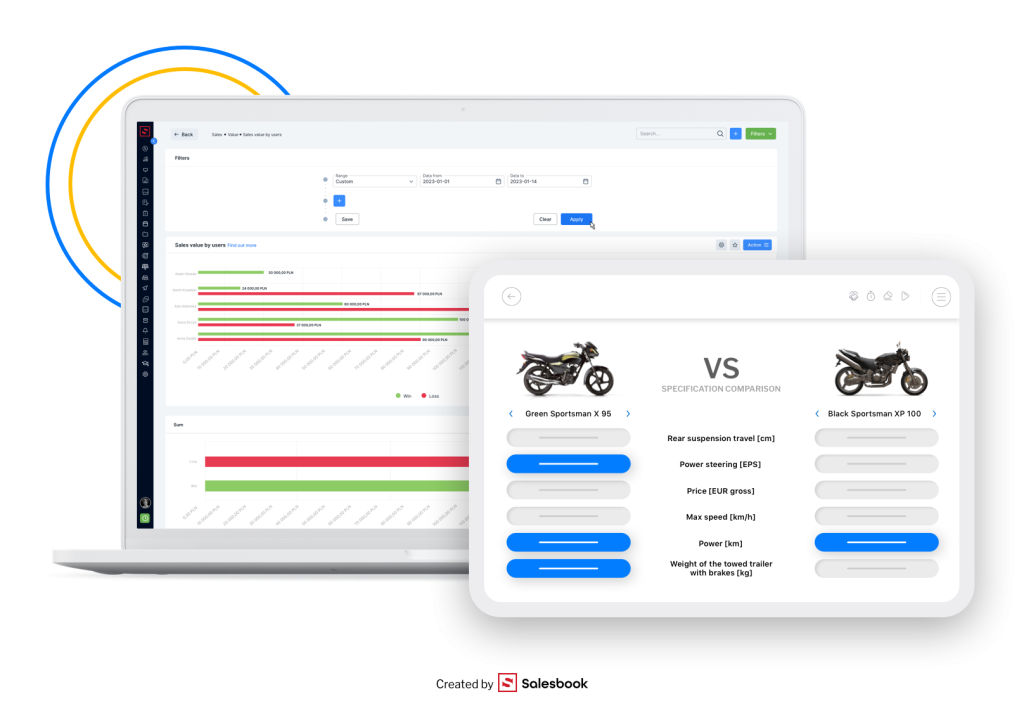
In Salesbook CRM, data isn’t just stored — it’s analyzed and visualized through intuitive dashboards. So, before you walk into a meeting, be prepared: review the history of concessions, average deal values, and sales cycle lengths. This data-driven approach helps you achieve better results because every decision is grounded in facts, not gut feelings.
CRM systems also help maintain communication consistency within the team. Thanks to shared notes and reports, everyone knows which stage the conversation is at and which solutions have worked best in similar situations before.

Offer Templates, Margin Calculators, and Meeting Checklists
Well-prepared materials are your shield and sword in negotiations. Offer templates help maintain consistent communication standards and make it easier to respond quickly to changing client expectations. Margin calculators, on the other hand, help you stay in control of profitability — enabling you to immediately assess which concessions are financially viable and which cross the line of acceptable margin.
Meeting checklists help structure the entire negotiation process — from preparing materials and organizing arguments to summarizing conclusions and planning the next steps. It’s a simple but powerful way to stay focused on your goals and avoid losing track in a dynamic discussion.
In practice, the best negotiators combine these tools into a cohesive ecosystem. The CRM provides the data, the calculator helps assess deal value, and the checklist reinforces key principles. As a result, the entire conversation becomes less emotional and more predictable, analytical, and professional — exactly how modern B2B sales should look.
Checklists and Templates for Practical Use
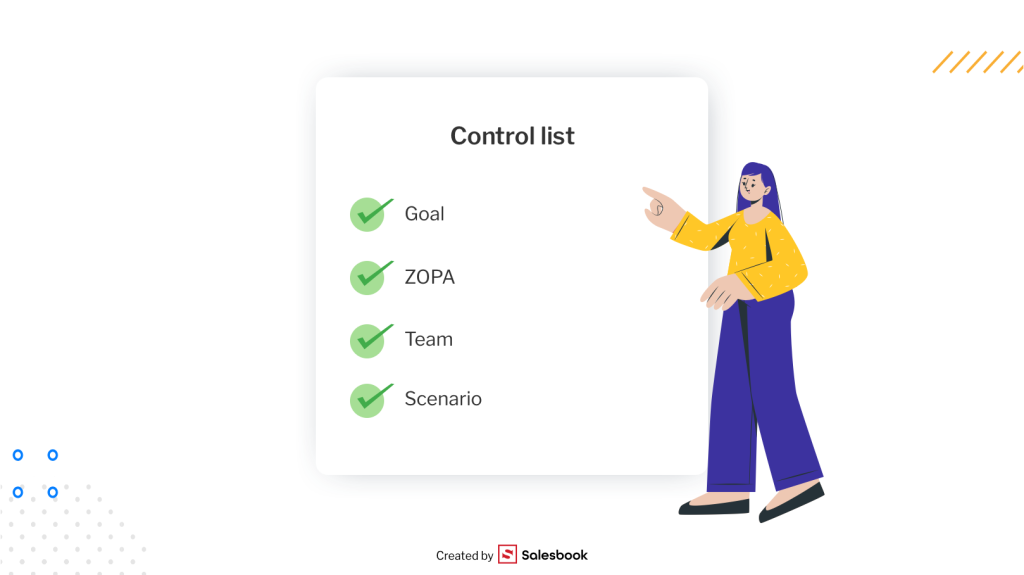
Even the most seasoned negotiator can make mistakes without structure. A good checklist is like a map — it keeps you oriented during the discussion and helps you refocus when emotions take over. The following checklists and templates can serve as ready-to-use tools in your daily work — before, during, and after every meeting.
Negotiation Preparation Checklist
Before the meeting:
1. Situation and Goal Analysis
- What are your key goals and priorities?
- What is your minimum acceptable outcome, and what would be the ideal result?
- Do you understand the other side’s goals and constraints?
2. Interests and Boundaries
- What are your interests, and what are the client’s?
- Which concessions can you offer in exchange for something specific?
- Where is your non-negotiable limit (hard conditions)?
3. BATNA and ZOPA
- Have you prepared your BATNA (Best Alternative to a Negotiated Agreement) in case no deal is reached?
- What does the potential ZOPA (Zone of Possible Agreement) look like?
4. Information and Data
- Do you have updated market data, pricing, and benchmarks?
- Which reports, insights, or CRM data can strengthen your arguments?
- Is your proposal based on facts and numbers, not assumptions?
5. Team Composition and Roles
- Who leads the meeting, and who serves as an observer or subject-matter expert?
- Does every team member know their role and when to contribute?
6. Conversation Scenarios
- What possible strategies could the other side use?
- How will you respond to pressure, objections, or tactical silence?
- What alternative solutions can you propose?
7. Materials and Tools
- Are your offer templates, margin calculators, and checklists ready?
- Are your slides and documents visually aligned with your brand and tone of voice?
Pro tip: Review all data and materials at least 24 hours before the meeting. In negotiations, small details determine credibility — and credibility determines success.
Post-Meeting Summary Template
Once the conversation ends, be the one who takes the initiative and sends a written summary. It’s not only a sign of professionalism — it’s also a way to maintain control over what happens next.
Sample email / meeting summary note:
Subject: Summary of Meeting Agreements – [Date]
Dear [Name],
Thank you for today’s conversation.
Below is a short summary of the key points we agreed upon:
- Scope of cooperation: [description]
- Financial terms: [price range, discounts, payment model]
- Timelines: [project phases, milestones, payment schedule]
- Additional obligations of both parties: [e.g., material delivery, tests, audits]
- Agreed trade-offs and concessions: [e.g., volume-based discount, training included]
Next steps:
- [Date] – submission of final offer/contract
- [Date] – confirmation of terms
- [Date] – start of cooperation
Final notes:
Please confirm that the above summary reflects your understanding of today’s discussion.
Thank you for the constructive conversation — I look forward to your confirmation.
Best regards,
[Name]
[Position]
[Company]
Pro tip: Sending a summary helps confirm facts and eliminate misunderstandings. It’s a simple yet powerful way to keep control of the follow-up process and ensure clarity on both sides.
FAQ – The Most Common Questions About Business Negotiations
1. Should you always aim for compromise in negotiations?
Not necessarily. A compromise means each side gives something up — and that’s not always required. Modern negotiation focuses on co-creating value and pursuing a negotiated solution that benefits both sides. Parties typically seek a better understanding of each other’s priorities to reach win–win outcomes where both achieve their core goals.
2. How long should B2B negotiations last?
There’s no universal timeline. The duration depends on offer complexity, the number of decision-makers, and the level of risk. In such cases, structure and clarity matter most — every phase should be carefully managed and documented to ensure a professional and predictable negotiating process.
3. What if the other side stays silent or avoids making a decision?
Silence can be a pressure tactic. Stay calm but proactive — ask calibrating questions, summarize what each party makes as a commitment, and verify whether procedural issues (like internal approval chains or budget reviews) are slowing down the process. Remember, silence is also data — it may signal that the other negotiator needs more time, clarity, or leverage to move forward.
4. How to react when a conversation becomes emotional?
Keep a fact-based tone. Instead of responding with emotion, redirect the discussion to numbers, data, and timelines. Skilled professionals negotiate calmly, even under stress. If tension escalates, suggest a short break or reschedule — that’s a sign of professionalism, not weakness.
5. How to prepare for negotiations with a larger partner or corporation?
Start with analysis. Gather data about their organizational structure, decision-making process, and purchasing limits. Large companies operate under strict procedures — understanding those procedural issues in advance is half the battle. Also, define your BATNA (Best Alternative to a Negotiated Agreement) before entering the meeting and be ready for negotiating multiple aspects, not just price.
6. Do tools like Salesbook CRM really help in negotiations?
Yes — because they organize data, track progress, and visualize insights. With integrated analytics, you can prepare stronger arguments, anticipate objections, and tailor your offer to the client’s profile. Such tools help professional negotiators stay in control of current negotiations and maintain focus on measurable outcomes.
7. What should you do after negotiations conclude?
Summarize all agreements in an email or meeting note, record details in your CRM, and review the negotiated solution. Every meeting is an opportunity to learn and build better understanding of what drives your client’s decisions. Even if the deal didn’t close, analyzing the process can strengthen your negotiation skills and prepare you for the next round of negotiating.
Table of Contents