 EN
EN  PL
PL 



Direct Sales – What It Is, Effective Techniques, and Examples


Direct selling has remained one of the most important methods of reaching potential customers for decades. Even though the world of commerce is increasingly shifting to digital and automated solutions, personal selling still holds enormous value. A sales representative meeting with a prospective customer face-to-face—or even through a hybrid online session—can achieve results that no mass marketing campaign can replicate. These one-on-one interactions allow for a deeper understanding of customer preferences, more tailored solutions, and stronger customer relationships built on trust.
This is the real power of personal selling: it gives sales professionals the ability to read body language, listen actively, adapt their sales pitch in real time, and deliver immediate feedback to customer concerns. Instead of relying solely on numbers or generic offers, direct selling enables customized conversations that create real value for the buyer. A well-trained sales representative not only highlights the features of products or services but also uses personal selling techniques that demonstrate how those solutions solve specific pain points.
In this article, we’ll explain what direct sales is, what benefits it offers, and what challenges it poses for sales professionals. We’ll also show proven personal selling strategies that help adapt communication to the unique needs of each customer and increase the likelihood of a successful sale. Finally, we’ll look at real-world examples of companies that have optimized their direct sales process and achieved repeat business through effective sales strategies.
What Is Direct Sales and Why Does It Still Work?
Direct sales—or direct selling—is the business model of presenting products or services directly to the customer without third-party retailers. A sales representative manages the personal selling process by engaging the customer in direct interaction, whether through home visits, trade shows, showrooms, or workplace meetings. This direct sales process provides immediate feedback, makes it easier to identify customer concerns, and ensures customer satisfaction by tailoring the offer to individual expectations.
So why does direct selling still work in the age of automation and digital campaigns? Because it is rooted in human psychology and the value of personal connection. A live conversation reduces uncertainty, strengthens trust, and naturally moves the prospective buyer toward a decision. Research published in Harvard Business Review shows that requests made in person are several times more effective than those sent via email. This confirms what sales leaders already know: personal relationships and authentic customer interactions remain at the heart of the selling process.
The most effective sales approach today is hybrid: combining the depth of face-to-face meetings with the reach of digital channels. McKinsey reports that this model preserves the impact of traditional personal selling while increasing the frequency of customer touchpoints and opening new future sales opportunities. By leveraging both online and offline channels, sales representatives can better identify potential customers, adjust their sales pitch, and drive sales more effectively.
In short: direct selling is a customer-centered business model built on trust, relationship building, and tailored solutions. Hybrid methods extend its reach, ensuring customer satisfaction while building stronger customer relationships that form the foundation for long-term success.

Direct Sales in Practice: History and Development of the Model
To fully understand direct sales, it’s worth looking back at its origins. In fact, the concept of personal selling dates as far back as ancient times. Historical records from markets in Greece and Rome show merchants using direct interaction to persuade prospective buyers. These early sales representatives didn’t just display products or services—they engaged in one-on-one interactions, built personal relationships, and relied heavily on product knowledge to convince customers. Their personal selling skills were the backbone of commerce long before the invention of retail stores or mass marketing.
Fast-forward to the 19th century, and we see the rise of traveling salespeople who brought everyday goods directly to households. Their effectiveness didn’t come from broad advertising campaigns but from the ability to tailor their sales pitch to the customer’s needs and respond to objections on the spot. This was the foundation of the modern personal selling process: understanding pain points, adapting communication, and ensuring customer satisfaction during direct customer interactions.
In the 20th century, direct sales scaled massively thanks to iconic companies such as Avon and Amway. Their strength lay in building large networks of sales representatives who operated within their own communities. This business model worked because it was based on trust, personal relationships, and continuous customer interactions. By meeting potential customers in their homes or workplaces, representatives could quickly establish rapport and build stronger customer relationships that led to repeat business.
Today, the direct sales process has been transformed by technology. Traditional door-to-door visits have largely given way to hybrid methods—online presentations, interactive mobile apps, and advanced CRM systems. Modern sales representatives combine consultative selling with personal selling techniques, using sales management dashboards and analytics to personalize the selling process, generate leads, and drive sales more effectively. Tools such as mobile CRM solutions make it easier to monitor each stage of the sales cycle, adapt the sales approach to customer preferences, and deliver customized solutions in real time.
Importantly, a report by Direct Selling Europe highlights that direct selling continues to show steady growth in the digital economy. Customers still value direct interaction, the ability to ask questions, and the reassurance of personalized offers. This flexibility—and the ability to build stronger customer relationships—explains why direct sales has not only survived but thrived alongside digital and automated channels.

Key Advantages and Challenges of Direct Sales
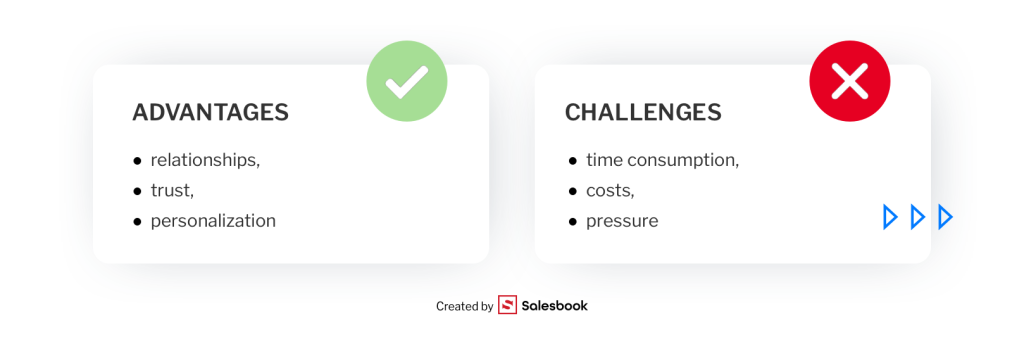
Direct sales is a method that demands strong skills from the salesperson—but at the same time, it provides advantages that no other channel can match. Success in this model depends not only on persuasive personal selling techniques but also on customer service skills that ensure customer satisfaction long after the initial contact. Let’s look at the main pros and cons of this approach.
Advantages of Direct Sales
- Direct customer contact – A face-to-face or hybrid conversation helps sales professionals better understand the buyer’s expectations, preferences, and pain points. It’s not just about presenting products or services but also about active listening, capturing customer feedback, and responding in real time. This direct interaction is the foundation of the personal selling process.
- Building trust and relationships – Personal selling thrives on authentic human connection. Through one-on-one interactions, sales representatives can build stronger customer relationships, laying the groundwork for repeat business and long-term loyalty.
- Tailored offers to individual needs – A skilled salesperson can immediately adjust their sales pitch, emphasizing tailored solutions that address specific customer concerns. This consultative selling approach highlights real value and ensures that offers align closely with the customer’s business or lifestyle.
- Greater effectiveness in negotiations – Personal meetings increase the likelihood of achieving a successful sale, as they enable the salesperson to handle objections on the spot and adapt their sales approach dynamically. This has a direct impact on sales performance and overall customer satisfaction.
Challenges of Direct Sales
- Time-consuming – Meeting each prospective customer individually often requires more time compared to mass marketing or automated campaigns. The selling process in direct sales typically involves multiple steps—from initial contact to closing—that extend the sales cycle.
- Higher costs – Organizing visits, travel, or live presentations is more resource-intensive than digital-only sales strategies. This can increase customer acquisition cost if not managed properly.
- High demands on salespeople – Effective direct selling requires more than enthusiasm. It calls for advanced personal selling skills, emotional intelligence, and the ability to balance storytelling with consultative selling strategies. A salesperson must master both the art of persuasion and the science of product knowledge.
- Limited scalability – One sales representative can only conduct a limited number of one-on-one interactions per day. This makes scaling the direct sales process more challenging compared to retail sales or e-commerce, and can impact long-term business growth if not supported by the right tools.
Practical Tip
To minimize these downsides, companies should adopt hybrid sales strategies. In-person meetings can be combined with online presentations, while CRM systems and mobile sales applications help salespeople track progress, analyze sales metrics, and maintain continuity in customer relationships. This hybrid sales approach maximizes efficiency, reduces customer churn, and helps build stronger customer relationships—without losing the most valuable element of direct sales: genuine human connection.
Effective Direct Sales Techniques
To make direct sales truly effective, enthusiasm alone isn’t enough. What matters most are proven personal selling techniques that help the salesperson guide the conversation, better understand the customer’s needs, and ultimately lead them to a successful sale. Below are some of the most recognized techniques used by sales professionals around the world.
1. Active listening and asking questions
One of the most underrated yet powerful skills in the personal selling process is active listening. Instead of launching directly into a sales pitch, successful sales representatives use questioning frameworks like SPIN Selling, developed by Neil Rackham. SPIN stands for Situation, Problem, Implication, Need-payoff—a structured way to uncover customer pain points and ensure the product or service is positioned as the best solution.
Example: Instead of asking, “Do you need insurance?”, the rep might ask, “What challenges do you face in protecting your family’s financial security?” This consultative approach not only deepens customer interactions but also lays the groundwork for building stronger customer relationships.
2. Presenting value, not just features
Customers don’t buy product specifications—they buy outcomes. This is the principle behind solution selling, popularized in the 1980s, where the focus shifts from features to benefits and tailored solutions. Sales reps connect product capabilities to the customer’s business challenges, ensuring the prospect clearly sees the real value.
Example: Instead of saying, “This software processes data quickly,” a salesperson might highlight, “This software reduces your processing time by 40%, saving your team 10 hours per week.” This clear link between features and benefits is a cornerstone of consultative selling.
3. Storytelling in direct sales
Humans are wired to respond to stories, not spreadsheets. That’s why storytelling is one of the most effective sales strategies in personal selling. It transforms abstract product features into real-world impact.
Classic Example: Xerox famously trained its sales teams to use success stories from existing customers as part of their sales presentations. Sharing how a similar company solved its pain points with the same solution makes the prospective buyer more confident and engaged.
Tip: A good story follows a structure—problem, solution, result—and connects emotionally while proving credibility with data or testimonials.
4. The closing technique
The closing stage of the selling process has been studied for decades. While early methods focused on aggressive sales tactics (“Would you like it in red or blue?”), today’s best practices emphasize soft closing and guiding the buying process.
Examples:
- The Assumptive Close – phrasing questions as if the decision is already made: “When should we schedule delivery?”
- The Alternative Close – giving the customer controlled options: “Would you prefer the annual package or the monthly plan?”
- The Consultative Close – aligning with customer concerns: “Which option gives you the most confidence moving forward?”
These methods help the sales representative avoid unnecessary pressure while still driving toward the final decision.
5. Using modern tools
Modern sales professionals rely on technology to elevate the direct sales process. Tools such as mobile CRM platforms (like Salesbook) empower reps to conduct sales calls, generate proposals instantly, and track every step of the sales cycle.
Benefits include:
- Access to product knowledge and digital catalogs on the spot.
- Real-time analytics showing how customers interact with offers.
- Automation of follow-ups, ensuring no prospective customer is forgotten.
By blending traditional personal selling skills with modern software solutions, sales reps ensure customer satisfaction, improve sales performance, and unlock future sales opportunities.

Building Relationships as the Basis of Effective Direct Sales
Direct sales is not just about exchanging products or services for money. It is primarily about implementing thoughtful direct sales strategies where the foundation is building meaningful, long term relationships. These relationships often start with the initial contact and, when managed well, can continue for years, generating repeat business and even referrals. Companies that focus solely on short-term wins often miss out on the numerous benefits that strong customer relationships can deliver.
1. Personalizing the conversation
Every customer belongs to a different target market and has unique expectations. That’s why personal selling requires adapting the message to the customer’s lifestyle, needs, and pain points. In business to business contexts, for example, this might involve tailoring the sales pitch to address a client’s specific business challenges, while in retail sales it could mean showing how the product improves daily life.
Unlike traditional retail channels, direct sales allows one-on-one interactions that are highly personalized. Salespeople who understand the value of customized solutions demonstrate genuine investment in customer preferences, increasing both trust and loyalty.
2. Building trust through transparency
Trust is the cornerstone of sales success. It is built not only by highlighting benefits but also by being transparent about potential limitations. This level of honesty is rare in mass marketing campaigns or traditional retail channels, but in direct sales it is essential for creating stronger customer relationships. By practicing consultative selling, sales representatives position themselves as advisors rather than just sellers, making it easier to ensure customer satisfaction and reduce customer churn.
3. Maintaining contact after the sale
The personal selling process doesn’t end with a signed contract—it evolves into a loyalty-driven relationship. Maintaining contact after the sale, through follow-up calls, thank-you messages, or even customer care via social media platforms, signals commitment to the customer’s success. In single level direct sales, where salespeople work independently, these small but consistent actions are what lead to future sales opportunities and create long-term partnerships.
4. Storytelling based on customer experiences
Storytelling is one of the most effective ways to build credibility. Sharing examples of how other clients benefited helps the prospective customer relate emotionally while receiving rational reassurance. For example, instead of relying solely on cold calling, a sales rep might use case studies or testimonials to demonstrate real value. This not only strengthens personal connections but also highlights the practical outcomes of choosing the right product.

Modern Tools Supporting Direct Sales
Direct sales in the 21st century looks very different from what it did 20 or 30 years ago. While salespeople once relied only on catalogs and notebooks, today they have advanced tools that make conversations easier and help build lasting customer relationships.
CRM – the salesperson’s command center
CRM systems have become an absolute standard. They allow sales teams to collect customer data, analyze history, and monitor every stage of the sales process. This helps salespeople better understand customer needs, personalize conversations, and propose more relevant solutions.
Mobile sales applications
Modern customers expect fast responses and personalized presentations of products and services. Mobile applications like Salesbook support sales reps at every stage of client interaction:
- creating interactive presentations tailored to customer needs,
- generating professional offers in real time,
- automating contract signing and CRM data transfer,
- providing analytics that shows which content engages customers most.
Thanks to such solutions, salespeople no longer have to juggle binders and laptops. Everything they need—from marketing materials to closing tools—is right at their fingertips.
Hybrid support in practice
Modern tools make it easy to combine in-person meetings with online presentations. This is a huge advantage in a world where clients are increasingly mobile and purchasing decisions are often made collectively. With an app like Salesbook, a salesperson can seamlessly switch from a face-to-face meeting to a video call while maintaining continuity of the relationship and full visibility of the sales process.

Examples of Brands Mastering Direct Sales
Avon – the classic of direct sales
Avon is the symbol of this model. The brand built a global network of salespeople who reach customers where they are—in homes, at gatherings, and in workplaces. Its strength lies in building relationships through personalized recommendations and direct product presentations.
Tupperware – meetings that became a phenomenon
The famous “Tupperware parties” proved that a sales meeting can turn into a social event. Sales reps demonstrated products in customers’ homes, answered questions, and tailored conversations to individual needs. This model is still considered a textbook example of effective direct sales techniques.
Tesla – innovation in premium sales
Although Tesla doesn’t do traditional home visits, it applies the principles of direct sales by eliminating intermediaries. Customers visit showrooms where advisors use digital tools to better understand needs and provide personalized offers. It’s a perfect example of how modern brands adapt direct sales to the realities of the 21st century.
Salesbook – the digital evolution of direct sales
Salesbook shows how to combine tradition with technology. With its mobile app, a salesperson can hold real-time conversations, present products, create personalized offers, and close deals with a single click. It proves that the power of direct, relationship-based selling can become even more effective when supported by technology.

Conclusion – How to Apply Direct Sales Techniques in Your Business
Direct sales has more than 150 years of history, yet its strength has not diminished. On the contrary—in an era of digitalization and automation, personal contact with the customer is a competitive advantage that mass campaigns cannot replace. This model is built on empathy, listening skills, and tailoring actions to individual customer needs.
To unlock the full potential of direct sales, keep a few principles in mind:
- Focus on relationships and trust – sales is not only about numbers, but above all about people.
- Implement effective sales techniques – from active listening and storytelling to pressure-free closing.
- Combine tradition with innovation – a hybrid approach (offline meetings + online presentations) helps scale operations and maintain continuity.
- Leverage technology – tools like Salesbook make it easier to present products, create offers, and monitor the entire sales process.
- Train soft skills – interpersonal skills are often what decide whether a conversation ends with a signed contract.
By combining classic methods with modern tools, your company can better understand customer needs, build stronger relationships, and close deals faster. Direct sales is not a relic—it’s the future and the path forward, provided you implement techniques that turn conversations into lasting partnerships.
FAQ – Direct Sales
What is direct sales?
Direct sales is a business model where sales representatives sell products or services directly to customers, without relying on traditional retail channels or third party retailers. This usually happens through one on one interactions such as face-to-face meetings, sales calls, or even hybrid formats like online video meetings.
How does direct sales differ from personal selling?
Personal selling is a broader concept that includes any selling process based on personal interactions. Direct sales is one form of personal selling, often structured through single level direct sales or multi-level networks. While all direct sales involve personal selling skills, not all personal selling is direct sales—for example, consultative selling in business to business markets may occur within a different framework.
What are the main advantages of direct sales?
Direct sales offers numerous benefits, such as immediate feedback from prospective buyers, the ability to tailor solutions to customer preferences, and building stronger customer relationships. It allows salespeople to ensure customer satisfaction more effectively compared to mass marketing.
What challenges do sales representatives face in direct sales?
The main challenges include time-consuming one on one interactions, higher costs compared to retail sales, and the need for advanced personal selling techniques. Additionally, scaling the direct sales process can be difficult since a salesperson can only meet a limited number of potential customers per day.
What are some proven direct sales strategies?
Successful direct sales strategies include active listening, storytelling, consultative selling, and adapting the sales pitch to the target market. Sales leaders also recommend combining traditional approaches like cold calling with modern tools such as CRM software solutions and social media platforms to generate leads.
How important is market research in direct sales?
Market research is crucial for identifying potential customers and understanding their pain points. It allows sales representatives to design personal selling strategies that are more relevant to the customer’s business, leading to a higher chance of a successful sale and repeat business.
Can direct sales be used in business to business markets?
Yes. While direct sales is often associated with retail sales or consumer products, many business to business companies use direct interaction to present software solutions, services directly, or complex products that require detailed sales presentations and customized solutions.
How does direct sales help build long term relationships?
Direct sales focuses on relationship selling rather than aggressive sales tactics. By maintaining customer interactions after the initial contact, offering tailored solutions, and responding to customer concerns, salespeople can build stronger customer relationships that lead to customer loyalty, repeat business, and future sales opportunities.
Table of Contents